
Forthcoming
The Malasakit Initiative
The Filipino Philosophy as a Corporate Strategy in the Age of AI and Digitalization
By Brad Geiser and Oscar Lopez
Join the Book Waitlist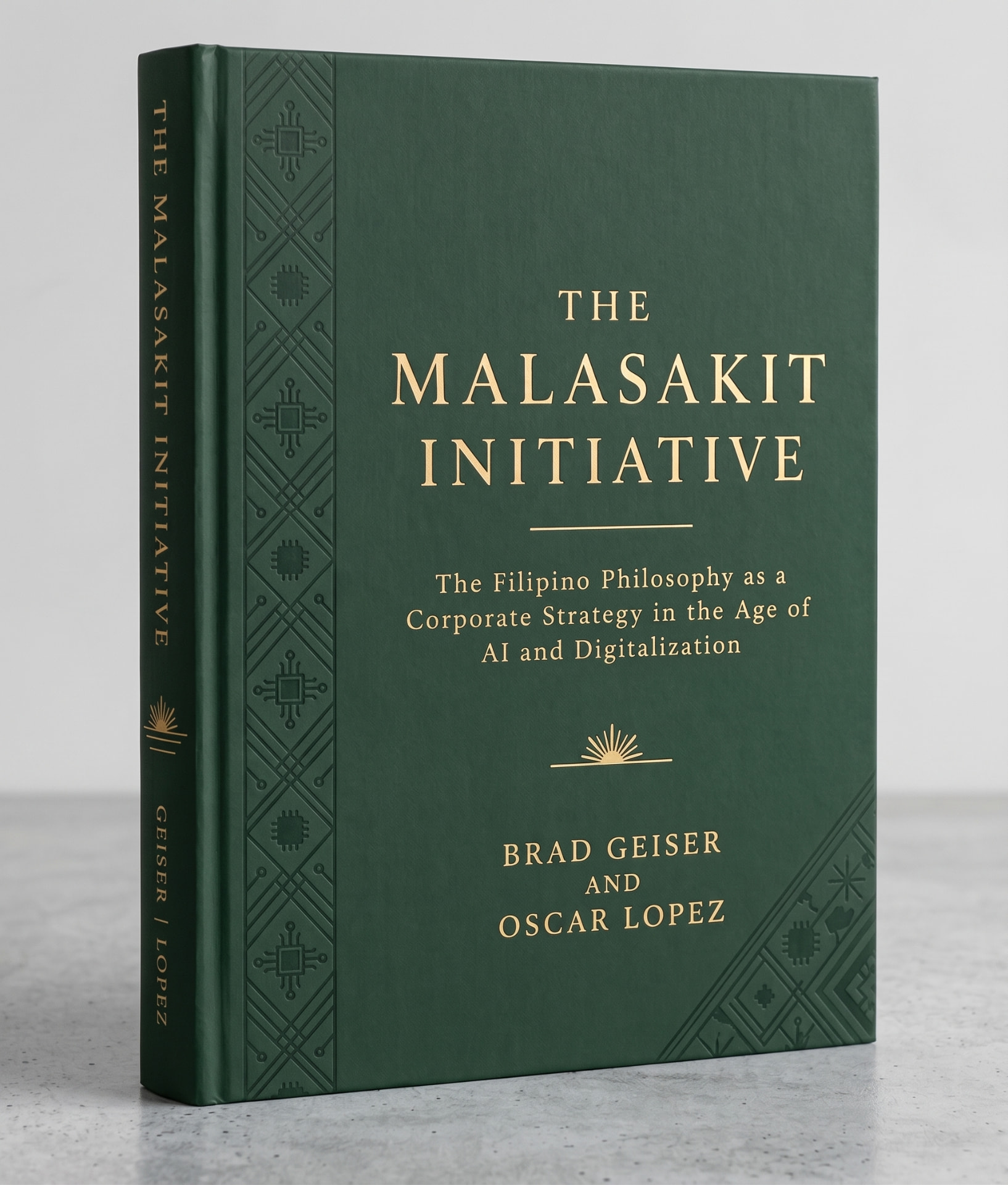
Introduction
The Call for a Human-Centric Movement
“Malasakit is the passion for the concerns of others.”
In 2023, I stood at what I believed was the peak of my entrepreneurial journey. My startup, Revastaff.com, had just won first place at Proptech Asia in Hong Kong, earning international recognition as one of the Philippines’ promising startups. At the time, I thought we had discovered a formula for success.
Looking back, however, I realize that we were operating largely on instinct. Without consciously designing it, our company culture was fueled by malasakit: a profound sense of shared identity and unconditional care. I knew our people by heart—their strengths and weaknesses, their ambitions, their quirks, and even their pet peeves. We did not have a sophisticated management playbook. We simply treated the company like a shared home and fiercely protected the people and clients within it.
It was chaotic, energetic, and intensely personal. But our people were deeply connected, and our growth was explosive.
Then I tried to engineer the perfect organization. Seeking to scale to the next level, I immersed myself in the Silicon Valley mindset. I gained access to respected startup mentors, international accelerator programs, and venture capital networks. I adopted the playbooks of high-growth companies. I became obsessed with metrics. I introduced increasingly rigid KPIs. I embraced the prevailing belief that efficiency, autonomy, and hyper-growth were the ultimate competitive advantages.
I began measuring what was easy to measure. Output. Productivity. Revenue. Utilization. Performance. I thought I was creating accountability. In reality, I was slowly changing the psychological contract between the company and its people. In my pursuit of optimization, I stripped away human friction—but I also stripped away the human soul. I prioritized the numbers over the people driving them.
The loyalty and shared ownership that had helped build Revastaff.com slowly began to erode. The company became more structured, but less connected. More efficient, but less human. That transformation ultimately contributed to my failure as a founder. Just a few years after winning that prestigious award, I exited the company—not in triumph, but painfully and ungracefully. That failure forced a hard reckoning.
We Have Perfected the Mechanics of Business but Starved Its Soul
For decades, modern corporate strategy has attempted to engineer the perfect organization. We have optimized supply chains, eliminated inefficiencies, built scalable digital infrastructures, and developed increasingly sophisticated systems for measuring performance. Businesses can now analyze enormous amounts of data, automate repetitive work, and coordinate global teams in real time.
And yet, amid this relentless pursuit of optimization, organizations are confronting an undeniable crisis. Burnout. Transactional relationships. Employee disengagement. The erosion of loyalty. We have become extraordinarily good at engineering the mechanics of business. But somewhere along the way, we began starving its soul.
The consequences are becoming increasingly visible. We often point fingers at the youngest generation entering the workforce. Gen Z is frequently labeled as a generation of “job hoppers,” supposedly lacking loyalty and commitment. But perhaps the problem is not the generation. Perhaps it is the environment.
Young people today are entering the workforce with an unprecedented number of alternatives to the traditional corporate career. They can build audiences as content creators, earn through affiliate commerce, freelance remotely for international clients, or participate in the growing gig economy. The traditional employer no longer holds a monopoly on opportunity.
When organizations treat people as resources to be optimized rather than human beings to be developed, talent simply exercises its options and walks away. The question is no longer: How do we retain people? The more important question is: Why would exceptional people choose to stay?
The Automation Paradox
At the same time, the rapid rise of artificial intelligence and digital transformation has led organizations into a dangerous trap. The prevailing corporate wisdom assumes that hyper-automation and autonomous execution are the ultimate competitive advantages. We are told that the future belongs to organizations that move faster, automate more, and remove as much friction as possible.
I believe the opposite may be true. In an era where automated execution is becoming cheaper and more widely accessible, human connection carries an even greater premium. The more technology automates the mundane, the more valuable distinctly human capabilities become. Trust. Judgment. Empathy. Creativity. Belonging. Loyalty. Meaning.
The more machines become capable of doing what humans do, the more valuable the things that only humans can give become. AI will not eliminate the need for human organizations. It will expose the difference between organizations that merely employ people and organizations that inspire them.
This is the automation paradox: as technology becomes increasingly powerful, humanity becomes increasingly valuable. To survive and thrive in this new landscape, enterprise leaders must adopt a radically different operating system—one rooted not in cold efficiency alone, but in proactive empathy. This is the foundation of the Malasakit Initiative.
A Filipino Competitive Advantage
I first encountered this idea through Brad Geiser. I met Brad when I appeared on The Final Pitch, where he served as one of the investor-judges. Years later, our paths crossed again, and we eventually became partners on several projects.
Through our conversations and collaborations, Brad introduced me to a provocative idea. Perhaps Filipino companies did not need to import every management philosophy from Silicon Valley, Japan, or the West. Perhaps one of our greatest competitive advantages was already embedded in our culture.
Together with his partner, Amor Maclang, Brad helped build GeiserMaclang into one of the Philippines’ most influential communications and advocacy firms. Through decades of working with organizations across industries, they developed a deep understanding of how Filipino culture shapes the way people communicate, cooperate, and respond to one another. At the heart of this understanding was a simple but powerful concept: Malasakit.
As I worked closely with them—and as I consulted with businesses of different sizes and industries—I began to see a recurring pattern. The more organizations I observed, the more convinced I became that Corporate Philippines might be overlooking one of its greatest advantages: Filipino values.
Why force organizations to imitate foreign management philosophies when our own culture already contains powerful principles of care, community, resilience, and shared responsibility? Rather than importing a corporate philosophy and forcing it upon our people, perhaps we should begin with values that Filipinos already understand intuitively.
That does not mean romanticizing Filipino culture. Every cultural strength has a shadow. Harmony can become conflict avoidance. Loyalty can become unhealthy obligation. Care can become paternalism. The purpose of this book is not to suggest that Filipino values are perfect. It is to identify their strengths, understand their limitations, and translate their most powerful principles into systems that can work in modern organizations.
What Is Malasakit?
In this book, malasakit is defined as the passion for the concerns of others.
But malasakit goes beyond conventional ideas of empathy. Empathy allows us to understand how another person feels. Malasakit compels us to care about what happens next. It is a profound sense of shared identity and responsibility. It is the instinct to protect and uplift those around us. It is the willingness to treat another person’s challenges and outcomes as if they were, in some meaningful way, our own.
Malasakit transforms concern into action. But malasakit should not be confused with softness. Caring about people does not mean lowering standards. It does not mean avoiding difficult conversations or tolerating poor performance.
In fact, genuine care often requires the opposite. It requires the courage to have difficult conversations. It requires leaders to demand excellence. It requires accountability. Indifference avoids discomfort. Malasakit confronts problems because it refuses to abandon people to them. This distinction is critical.
The Malasakit Initiative is not an argument for replacing business discipline with sentiment. It is an argument for recognizing that sustainable performance is ultimately produced by human beings.
The Human Counterpart to Kaizen
For generations, organizations around the world have looked to management philosophies such as Kaizen to improve performance through continuous improvement. Kaizen asks: How can we make the work better?
The Malasakit Initiative introduces a complementary question: How can we make the people doing the work stronger, more connected, and more capable of succeeding together?
While we continuously improve the process, how deliberately do we improve the human experience of the people within it? While Kaizen focuses on continuous improvement in the work, Malasakit focuses on continuous investment in the people who perform the work. The distinction is vital.
Processes do not innovate. People do. Systems do not build trust. People do. Technology does not create loyalty. People do. The Malasakit Initiative does not seek to replace operational excellence, technology, or performance management. It seeks to humanize them.
It recognizes that the greatest organizations are not built by choosing between performance and people. They are built by understanding that, in the long run, performance depends on people.
A New Baseline for the Modern Enterprise
The Malasakit Initiative is not a soft or utopian ideal. It is a rigorous corporate strategy. It establishes a new baseline for the modern enterprise: When employees and customers are genuinely cared for, sustainable business success becomes easier to build.
Organizations that create environments where people feel seen, supported, challenged, and valued build something far more powerful than temporary employee engagement. They build belonging. And belonging creates loyalty. Loyalty creates commitment. Commitment creates extraordinary work.
In an increasingly transactional world, that may become one of the most powerful competitive advantages an organization can possess. The companies that will win the future will not necessarily be those with the most automation, the most capital, or even the most sophisticated technology. Those advantages will increasingly become accessible to everyone.
The companies that endure will be the ones that people choose to belong to. The Malasakit Initiative is a call to action for leaders who are ready to restore the soul of business. It is a challenge to rethink what performance means. It is an invitation to build organizations where people do not simply work for a company, but genuinely care about what happens to it—and to one another.
In the age of artificial intelligence, the ultimate competitive advantage may be something profoundly human. It may be malasakit.
- Oscar Lopez
Key Themes
Inside the book.
- 01
The Crisis of Modern Capitalism
- 02
The Filipino Philosophy of Care
- 03
Care as Competitive Advantage
- 04
Human-Centered Leadership
- 05
The Future of Work
- 06
Technology and Humanity
- 07
ESG and Corporate Responsibility
- 08
Building Companies That Matter
- 09
The Malasakit Economy
Waitlist
Be first to read it.
Join the waitlist for publication news, early excerpts and launch events.